
Holiday operations
A practical guide to planning around employee time off, busy travel periods, and the operational work behind every trip.
Jump to the five-step coverage planPicture a December evening. A corporate event changes its pickup time, a flight arrives later than expected, and a new reservation inquiry comes in while your team is preparing the next morning's airport trips. One of your experienced reservationists is on vacation. The employee covering their work is already helping dispatch.
The challenge is the overlap: several customers need attention at the same time, and fewer trained people are available to provide it.
For chauffeur, black car, and shuttle operators, a holiday staffing plan should account for the work behind each ride as well as the vehicles and chauffeurs delivering it. Reservations, trip monitoring, customer updates, and shift handoffs all need clear ownership.
Planning that coverage early gives your employees room to take time off and gives your customers a dependable point of contact.
The holiday staffing overlap shows up in the data
Vacation Tracker's November 2026 Leave Trends Report found that late December was the busiest week for vacation in its U.S. customer data, accounting for 5% of yearly vacation days. That percentage describes recorded vacation days across the year, not the share of employees absent at once. The report draws on customer records from November 2024 through October 2026. [1]
Holiday airport activity can also be substantial. As a recent benchmark, AAA projected 8.03 million domestic air travelers during the December 20, 2025–January 1, 2026 holiday period, 2.3% more than in 2024. That was a forecast for domestic leisure travel, not a count of chauffeured transportation bookings. [2]
Use those figures as context, then build the staffing plan around your own business. A corporate-heavy operator may see some accounts slow down while airport transfers or private events become more demanding. The useful comparison is your expected workload against your available team, shift by shift.

The workload behind every trip
More work and fewer staff hours can compound quickly
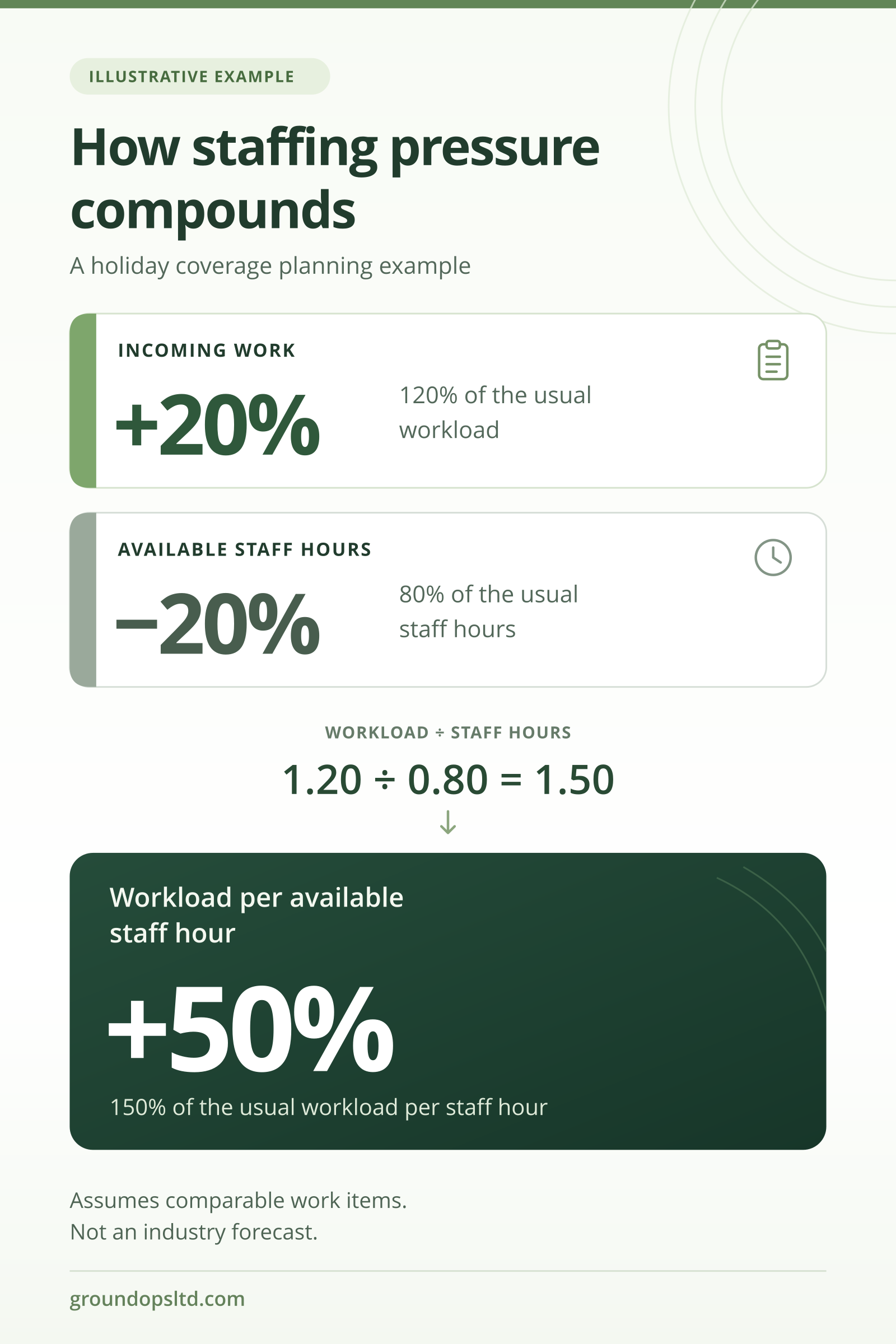
Consider a simple illustration: if incoming work increases 20% while available staff hours decrease 20%, the work per available hour rises 50%.
1.20 ÷ 0.80 = 1.50 This is an illustrative example, not an industry forecast. It assumes comparable work items; actual staffing needs depend on task complexity, handling time, and when the work arrives.
That helps explain why a modest increase in bookings can feel much larger to a smaller team. A daily trip count also misses the interruptions around those trips. One flight change may require an updated reservation, chauffeur communication, a customer response, and a review of the next assignment.
Build your plan around that operational workload. A vehicle schedule and a reservations inbox tell you different things about the support a shift needs.
View the full-size infographic (opens in a new tab)
Build your holiday coverage plan in five steps
01 Review demand by shift
Start with last year's holiday booking patterns, your current reservations, and known events. Compare bookings at the same lead time where possible: this year's reservations two weeks before a holiday should be compared with what was booked two weeks before last year's holiday, rather than its final completed volume.
Then look for concentrated work: early airport departures, evening arrivals, company events, late pickups, and return travel after Christmas or New Year's. Review call and email activity alongside trip volume if you have those records.
Overlay approved time off and pending requests. Include supervisors and owners in the calendar so their availability is explicit, too.
02 Name a primary and backup for each critical function
For each vulnerable shift, write down who handles new inquiries, existing reservation changes, active-trip issues, and the next shift's preparation. Confirm that the person has the software knowledge, access, and authority needed for the assigned work.
Use these fields to build a coverage worksheet for each shift where holiday demand and time off may overlap:
| Planning field | What to record |
|---|---|
| Date and coverage window | Exact start and end times, including the time zone. |
| Expected work | Active trips, likely inquiries, known events, and recurring checks. |
| Primary coverage | The named person or team responsible for each function. |
| Backup coverage | A confirmed backup and the conditions that trigger their involvement. |
| Readiness | Required system access, procedures, and training completed. |
| Decision authority | Who can approve exceptions, change assignments, or authorize affiliate use. |
| Handoff | Where open issues are recorded, who receives them, and when ownership changes. |
Look for duplicated assignments. If the same manager is the backup for reservations, dispatch, and customer escalations during your busiest window, check what happens when those needs occur together.
Review chauffeur and vehicle availability alongside office coverage so that the operation can deliver the trips the desk is supporting.
03 Put company knowledge into usable procedures
An experienced employee may know a corporate client's pickup preferences, which affiliate to contact, or when a change requires a supervisor. Put that information where the person covering the shift can find it.
Keep the instructions focused on the work that will be assigned:
- Reservation entry and changes, including required contact details and trip notes.
- Account-specific pickup instructions, service requirements, and communication preferences.
- Flight monitoring, chauffeur updates, and the checks needed before upcoming trips.
- Approved pricing rules and who can authorize an exception.
- Escalation contacts, including a backup if the first contact does not respond.
Be explicit about which actions the covering team can complete independently. Someone may be authorized to update a passenger's arrival time while a vehicle reassignment or affiliate commitment requires supervisor approval.
04 Rehearse a realistic overlap
Before the first supported shift, walk through a short scenario in your actual workflow. For example: an airport arrival is delayed, an event organizer changes a pickup, and a new customer requests a quote at the same time.
Ask each person to explain what they would do, where they would record the change, and when they would involve a supervisor. Check that the team can access the right information and that messages reach the intended contact.
The walkthrough should reveal unresolved details while there is still time to fix them. It also establishes the division of responsibilities between your internal team and any outside support.
05 Make the handoff part of the coverage
Before a shift ends, review upcoming pickups and leave a concise record of anything still open. Include the trip reference, current status, customer or chauffeur contact already made, next action, and person responsible.
Flag reservations awaiting confirmation, unresolved trip changes, and decisions that need a supervisor. Confirm that the incoming person has received the handoff.
During the holiday period, keep a small set of checks visible: unanswered inquiries, pending confirmations, unresolved exceptions, and issues carried into the next shift. Agree in advance which items need immediate attention and which can wait for the next team.
Give employees a clear path to taking time off
Ask about holiday plans early enough to arrange coverage, communicate decisions clearly, and tell employees who will own their responsibilities while they are away. Build around approved leave and identify unresolved requests before finalizing the schedule.
A useful test is whether an employee can explain who is covering their work without adding that they will keep checking messages throughout their vacation. If the schedule still depends on someone who is supposed to be off, make that dependency visible and resolve it.
Apply the same test to the owner. Time away is easier to protect when routine decisions have assigned owners and genuine escalations follow a clear path.
Where GroundOps can support the plan
GroundOps provides trained operational support for transportation companies, including reservations, dispatch, after-hours coverage, and billing workflows. Our teams work within operators' systems and processes, with training in booking workflows, affiliate coordination, trip monitoring, and operational communication. [3]
For holiday planning, start with the specific gap your worksheet identifies. That might be overflow reservations, an evening or overnight coverage window, or dispatch assistance during peak hours. We offer support models built around these operational needs. [3]
Software familiarity is an essential starting point. The coverage plan also needs to reflect how your business serves its accounts, handles exceptions, and passes work between shifts. Define those responsibilities and procedures before support begins.
Start the conversation early enough to discuss availability, scope, and onboarding. Bring your dates, coverage windows, software platform, expected workload, and the responsibilities you want covered.
Plan the coverage before the calendar fills
Your holiday staffing plan should make it clear who is available, what they own, and how they get help when several demands arrive together.
Putting that plan in place gives your team a more manageable schedule and gives customers consistent support through every reservation, change, and pickup.
Planning around holiday vacations and a busy reservation calendar? Talk with GroundOps about the support your operation needs.
Discuss Your Holiday Coverage Needs