
When Should a Transportation Company Outsource Dispatch?
Dispatch is one of the most important functions inside a transportation company. It is where reservations become live trips, where driver communication happens, where customer expectations are protected, and where small issues either get solved quickly or turn into service failures.
For limo, black car, shuttle, and corporate transportation operators, dispatch is not just a back-office task. It is the control center of the business.
But as an operation grows, dispatch can also become one of the first places where pressure starts to build. More trips, more drivers, more affiliates, more schedule changes, more flight updates, more customer communication, and more after-hours coverage all add complexity.
At some point, many transportation companies face the same question: should we keep handling everything internally, hire more staff, or outsource part of our dispatch operation?
The answer depends on your business, your trip volume, your coverage needs, and how much strain your current team is under. Below are the most common signs it may be time to consider outsourced dispatch support.
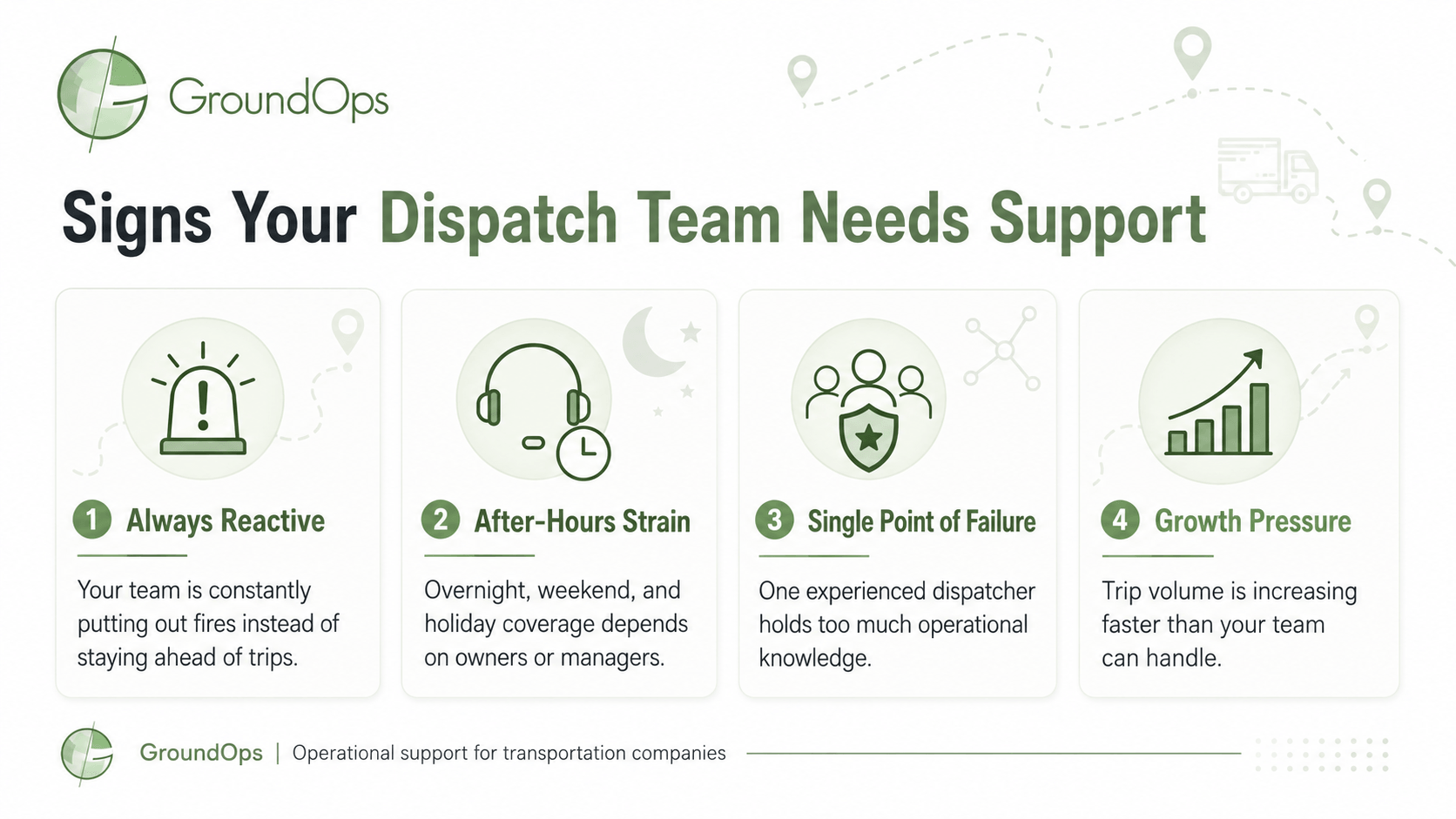
1. Your Dispatch Team Is Always Reacting
A strong dispatch operation should be proactive. Dispatchers should be monitoring trips, confirming details, communicating with chauffeurs, checking flight changes, coordinating affiliates, and staying ahead of problems before they affect the passenger.
If your team is constantly reacting, something is off.
Common warning signs include drivers calling for information they should already have, customers asking for updates your team has not sent yet, trips being monitored only when something goes wrong, flight changes creating last-minute confusion, and office staff stepping into dispatch because the desk is overwhelmed.
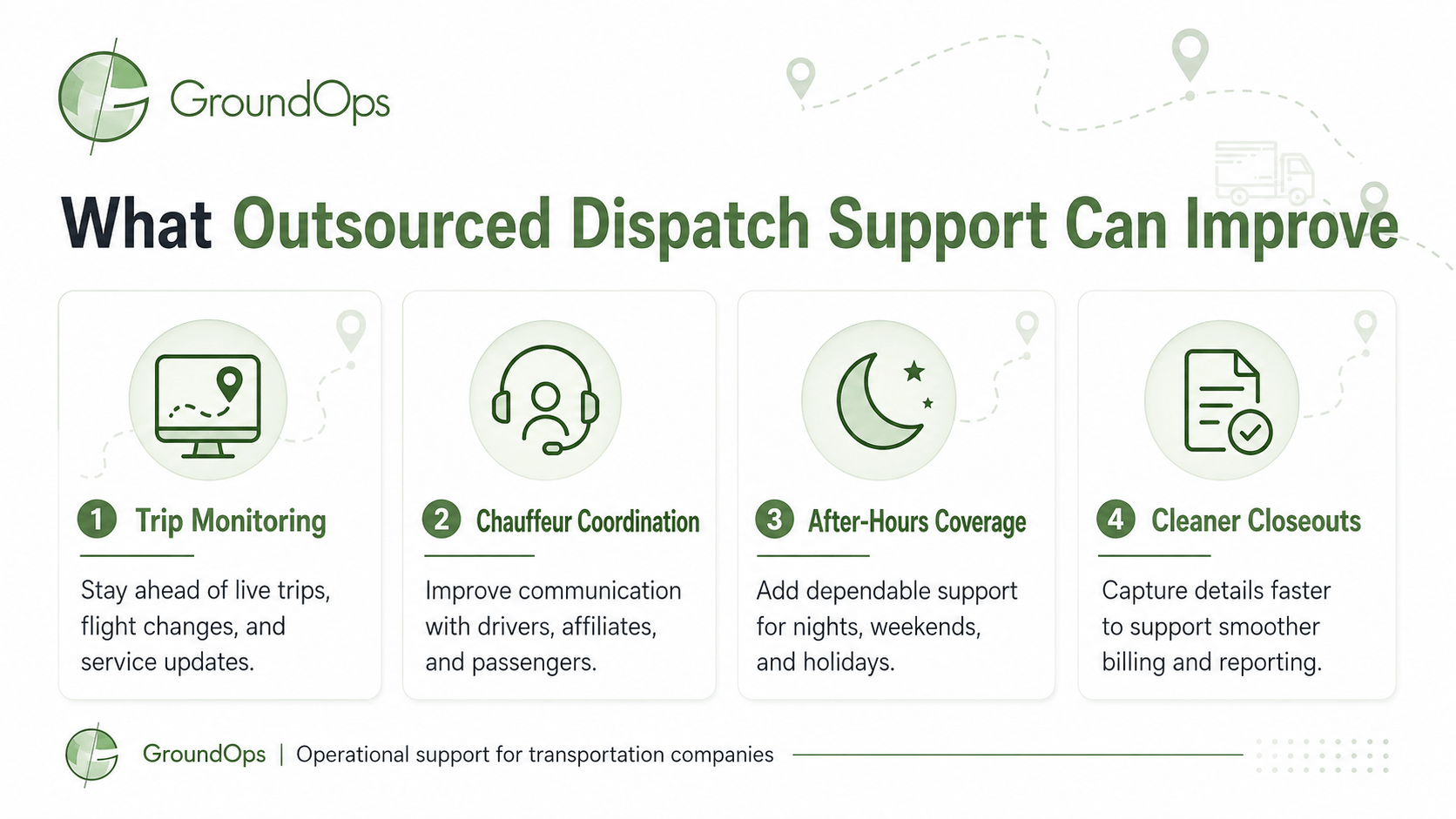
When dispatch becomes purely reactive, service quality becomes harder to protect. Outsourced dispatch support can help by adding trained coverage around the live trip process, allowing your internal team to focus on higher-priority decisions and customer relationships.
2. After-Hours Coverage Is Creating Stress
Many transportation companies are busiest when the office is least staffed.
Early morning airport departures, late-night arrivals, weekend events, delayed flights, and last-minute passenger updates often happen outside normal business hours. For operators, this creates a difficult staffing problem.
You need coverage, but full overnight staffing can be expensive. At the same time, having owners, managers, or dispatchers “keep an eye on things” from home is not a reliable long-term solution.
After-hours pressure usually shows up in a few ways: managers checking dispatch late at night, owners answering calls after hours, drivers waiting too long for updates, passengers not receiving timely communication, delayed flights creating operational gaps, and morning teams walking into unresolved overnight issues.
If after-hours coverage depends on one or two people always being available, the operation is vulnerable. Outsourced dispatch support can create a more consistent coverage model for nights, weekends, holidays, and low-volume shifts where hiring a full internal team may not make financial sense.
3. You Are Growing, But Not Ready to Hire Another Full-Time Dispatcher
Growth creates a staffing challenge. The business may need more dispatch coverage, but not enough to justify another full-time employee.
This is especially common when an operator is adding vehicles, taking on more airport work, expanding corporate accounts, supporting more affiliates, or moving into shuttle and group transportation.
The operation needs more support, but the workload may not fit neatly into a traditional full-time role.
Outsourcing can help bridge that gap.
Instead of waiting until the team is completely overwhelmed, operators can use outsourced dispatch support to add flexible capacity. This can be especially useful during peak travel windows, seasonal demand increases, large events, weekend coverage, overnight shifts, staff vacations, and employee turnover.
The goal is not always to replace internal dispatch. In many cases, the best model is a blended approach where the internal team owns the highest-value decisions and the outsourced team supports routine monitoring, updates, coordination, and coverage.
4. Your Best Dispatcher Has Become a Single Point of Failure
Many transportation companies rely heavily on one highly experienced dispatcher or operations manager. That person knows the customers, the drivers, the affiliates, the system, the exceptions, and the unwritten rules that keep the operation moving.
That experience is valuable, but it can also create risk.
If one person holds too much operational knowledge, the business becomes vulnerable when that person is out sick, on vacation, unavailable, or leaves the company.
Signs of a single-point-of-failure problem include only one person knowing how to handle certain accounts, only one person understanding the dispatch workflow, the team struggling when a key dispatcher is away, new staff depending too heavily on one experienced employee, and operational knowledge not being documented.
Outsourced dispatch support can help reduce this risk by creating more process consistency. A trained support team can follow defined workflows, assist with routine coverage, and help document repeatable steps so the business is less dependent on one individual.
5. Communication Gaps Are Starting to Affect Service Quality
In ground transportation, communication is part of the service.
Passengers expect updates. Chauffeurs need clear instructions. Affiliates need timely coordination. Corporate clients expect professionalism. Dispatch needs accurate, current information at every stage of the trip.
When communication breaks down, the customer may not see the internal reason. They only experience the result: confusion, delays, missed expectations, or a lack of confidence.
Dispatch communication issues often include drivers not receiving updated trip details, passengers asking for ETAs that have not been provided, affiliates not confirming final charges or changes, dispatch notes not being updated in the system, and customer service and dispatch working from different information.
Outsourced dispatch support can help create more consistent communication habits. This includes monitoring trip status, updating records, coordinating with chauffeurs, following up with affiliates, and helping ensure the system reflects what is actually happening in the field.
6. Billing and Trip Closeout Are Getting Delayed
Dispatch does not end when the passenger is dropped off.
For many operators, dispatch accuracy affects billing accuracy. If wait time, stops, parking, tolls, extras, affiliate charges, or trip notes are not captured correctly, revenue can leak out of the business.
This is where dispatch and back-office operations often overlap.
Delayed or incomplete trip closeouts can create problems such as missed extra charges, inaccurate invoices, slow customer billing, affiliate payment delays, customer disputes, more manual follow-up at month-end, and operations and accounting teams chasing missing details.
If your team is consistently behind on trip updates, closeouts, or final charge validation, outsourced support may help stabilize the workflow. Dispatch support can work alongside billing and accounting processes to help make sure trip information is cleaner, more complete, and easier to invoice.
7. Your Internal Team Is Spending Too Much Time on Routine Tasks
Not every dispatch task requires your most experienced internal person.
Many important tasks are repetitive but still need to be handled accurately. These may include checking trip status, confirming assignments, monitoring flight changes, updating notes, following up with affiliates, or sending routine customer communications.
When senior team members spend too much time on routine work, they have less time for the work that truly requires their judgment.
That may include managing high-value accounts, solving complex service issues, training staff, improving workflows, reviewing performance, supporting sales and client retention, and planning capacity for future growth.
Outsourced dispatch support can help absorb routine operational work so your internal leaders can focus on the decisions and relationships that have the greatest impact on the business.
8. You Need More Coverage Without Losing Control
One concern operators often have is whether outsourcing means giving up control.
It should not.
The right outsourcing model should support your process, your software, your standards, and your team’s expectations. For transportation operators, this is especially important because dispatch is not generic call center work. It requires understanding trip flow, chauffeur communication, customer expectations, affiliate coordination, airport timing, and the systems used to manage the operation.
Outsourced dispatch works best when it is built around clear workflows, defined responsibilities, and strong communication between the internal and external team.
That means deciding which tasks stay internal, which tasks can be supported externally, what hours need coverage, how handoffs should work, what issues require escalation, how updates should be documented, and what service standards need to be followed.
When done correctly, outsourcing does not replace operational control. It gives the operator more consistent support while keeping the business in charge of the process.
Outsourced Dispatch Is Not Just About Cost Savings
Cost is often part of the conversation, but it should not be the only reason to consider dispatch support.
The better question is: where is the operation under-supported, and what would better coverage make possible?
For some companies, the answer is fewer missed calls. For others, it is better after-hours coverage, cleaner handoffs, faster trip updates, more accurate billing, or less pressure on the owner and internal team.
The real value of outsourced dispatch support is operational stability.
It helps create more consistent coverage, stronger communication, and better follow-through across the trip lifecycle.
When It May Be Time to Consider Outsourced Dispatch
- Dispatch is becoming reactive instead of proactive.
- After-hours coverage is inconsistent or stressful.
- The team is missing calls, updates, or trip details.
- One person holds too much operational knowledge.
- Billing delays are tied to incomplete trip information.
- Internal staff are overloaded with routine work.
- Growth is outpacing the current team’s capacity.
- The company needs better coverage but is not ready for another full-time hire.
If several of these sound familiar, outsourcing may be worth exploring.
Final Thought
Dispatch is too important to leave stretched thin.
As transportation companies grow, the operational pressure increases. More trips, more customers, more drivers, more affiliates, and more after-hours needs all require a stronger support structure.
Outsourced dispatch support gives operators a way to add capacity, improve coverage, and protect service quality without immediately adding more internal headcount.
For many limo, black car, shuttle, and corporate transportation companies, the right question is not whether dispatch should be internal or outsourced.
The better question is: what parts of dispatch should your internal team own, and what parts could be supported more efficiently with the right partner?
Request a GroundOps Meeting
GroundOps helps transportation operators support reservations, dispatch, after-hours coverage, billing, and back-office workflows with trained operational support.
If your team is stretched thin, after-hours coverage is creating stress, or growth is putting pressure on your dispatch desk, GroundOps can help you evaluate where outside support may fit.
Request a Meeting